Simulation buys robotics teams time. It catches problems before they reach the real world and covers more scenarios than any field trial. That holds only when the simulator keeps pace with the test suite. Once it falls below real time, or every new scenario means copying configuration files by hand, the simulator turns into one more system the team has to maintain. An autonomous last-mile delivery company brought Ekumen that exact problem.
Highlights
A team building sidewalk delivery robots now finds problems in simulation before its robots meet the street.
- The robot software now runs against simulated sensors at full speed, so test runs stay stable.
- A new test scenario takes minutes to set up, down from hours.
- Every failure found in the field becomes a permanent automated test, re-run whenever the code changes.
The challenge
The client’s engineering team was scaling fast, and its simulation infrastructure had to keep up. Its simulator, an early prototype on NVIDIA® Isaac Sim™, an open-source robotics simulation framework, worked for initial tests, but four constraints limited how far it could grow:
- A convoluted data pipeline: Sensor data passed through several intermediate steps before reaching the robot stack, adding execution overhead at every hop.
- Throughput was below real time: The simulation was still a PoC with no performance optimization applied. The robot stack synchronizes on the system clock, so a simulator running slower than real time destabilized testing.
- Manual configuration overhead: Every new scenario meant copying configuration files by hand, and the workload grew with the test suite.
- Expanding kinematics and sensor needs: The platform needed to support more advanced kinematic models and a wider sensor suite for downstream robotics tasks.
The joint effort targeted an architectural refactor: faster execution, direct middleware integration, a simpler developer workflow, and configuration flexible enough to grow with the test suite.
The solution
Engineers at Ekumen, a Grid Dynamics company, kept the client’s core simulation assets and rebuilt the infrastructure underneath them.
Direct stage callbacks
The team attached directly to Isaac Sim’s stage events, so sensor data reaches the client’s communication middleware the moment it exists in memory. The intermediate bridges, their format conversions, and the latency they added are gone.
NVIDIA Fabric for scene updates
Objects that move along predefined paths now update the scene graph through NVIDIA Fabric instead of standard Universal Scene Description (USD) APIs. That cuts runtime memory and CPU overhead.
One configuration format and one CLI
Configurations share a single stable format, and a CLI with auto-completion launches any environment. Parameter ranges set in configuration templates expand into a full combinatorial test matrix, so an edge case becomes a reproducible set of runs.
Kinematics and sensors
The team updated the robot’s kinematic models and added publishing for cameras, GPS, and NVIDIA RTX™ LiDAR. The simulation stack stayed stable across multiple Isaac Sim releases.
The results
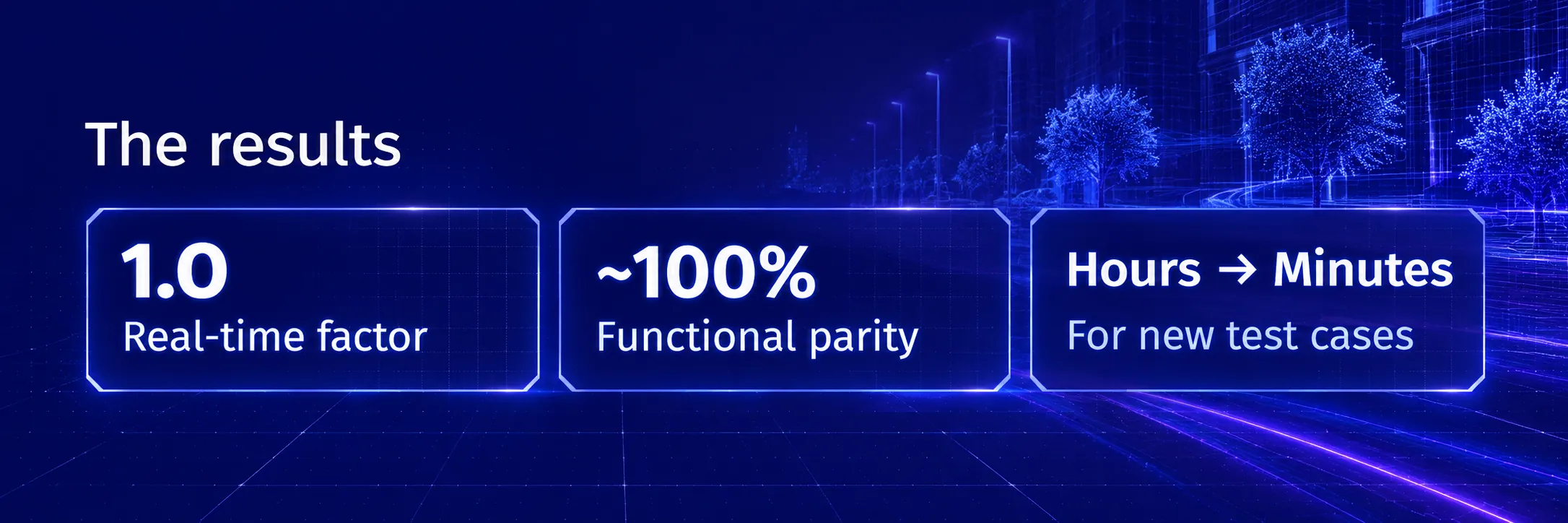
With the communication bottlenecks gone and NVIDIA USDRT Fabric in place, the simulator meets the real-time demands of the robot stack.
- The simulator holds 1.0 real-time factor (RTF), meaning simulated time matches the wall clock, while the full functional sensor suite publishes.
- The simulated robot and the physical software stack integrate with close to 100% functional parity.
- Engineers create and launch a new test case in minutes instead of hours.
- System integrators turn edge cases found in the field into automated local regression tests, which feed the robot’s development roadmap.
With setup down to minutes, the team spends its time validating robot behavior and chasing edge cases.
Next step
Is your simulator becoming a project of its own, or is the gap between simulation and robot behavior widening? Ekumen’s simulation team has been in that spot with other teams. Talk to them.