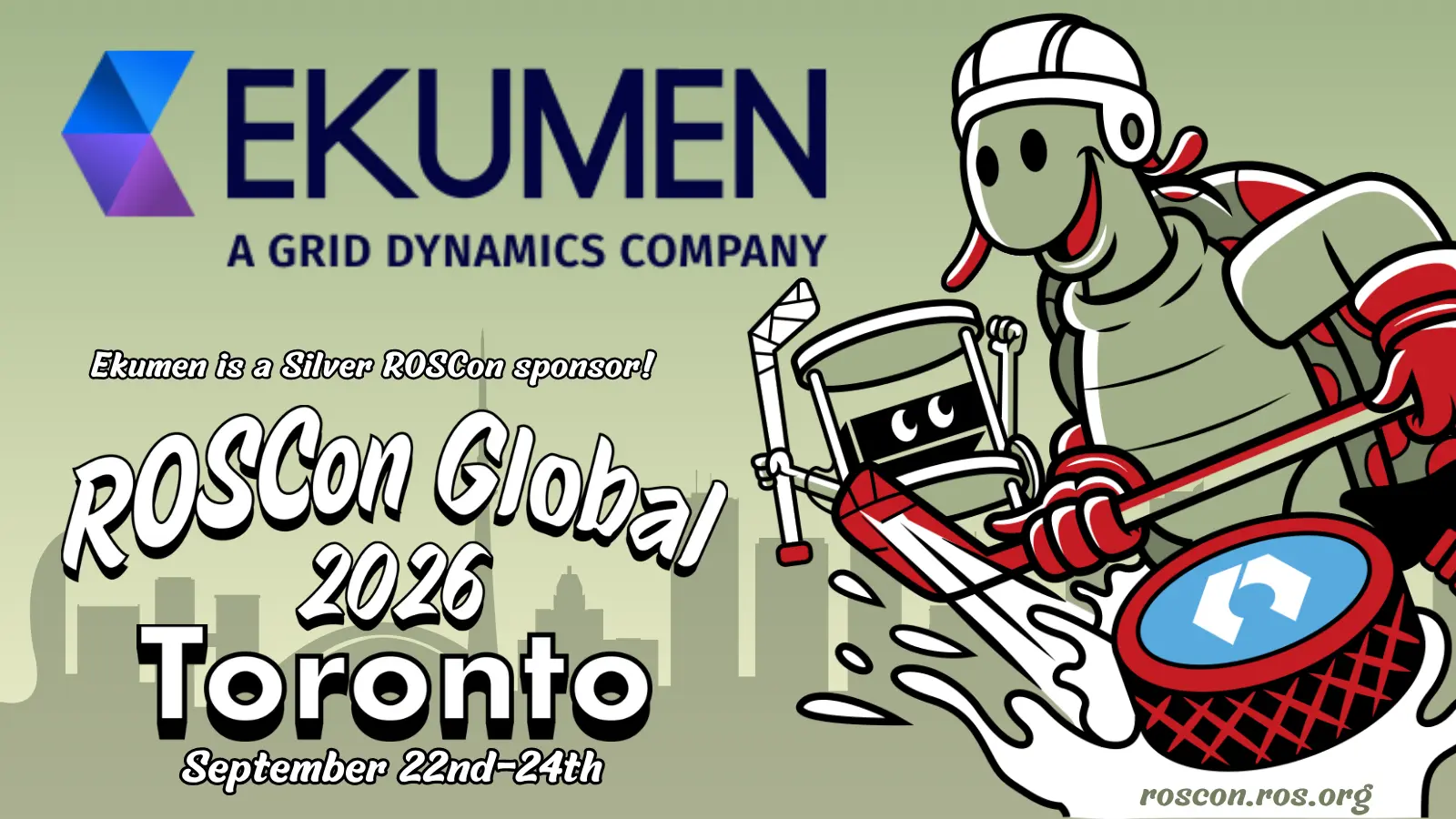
We’re heading to Toronto for ROSCon 2026, September 22 to 24, as a Silver sponsor. If you’re around the Sheraton Centre, stop by Booth #20: three demos running across Physical AI, LeRobot, Isaac Sim, ROS 2, and Nav2.
Who’s coming
- Florencia Grosso, Business Director, Americas
- Javier Balloffet, Engineer Manager, EMEA
- Patricio Reyna Almandos, Managing Partner
- Clara Berendsen and Jorge Pérez, our buildfarm team
- Michel Hidalgo, Senior Robotics Software Engineer
- Franco Cipollone, Simulation Engineer
- Gonzalo de Pedro, Ariel Lowy, and Juan Esteban Camacho, our Account Management team
- Sofia Venancio, Marketing Lead
What we’re presenting
This year we’ve got four talks and a Birds of a Feather session:
-
Alternative package managers in the wild (Birds of a Feather), Tuesday, Sept 22, 4:00–4:55 PM, Simcoe + Dufferin. Hosted by Clara Berendsen. Bring your own experience deploying robots with these tools, what works, what fails, what dragons you’re still fighting in production. Open to robotics engineers, DevOps folks, and tooling nerds who want to compare notes.
-
Mines, Motors, and Manipulation: Architecting Modern ROS 2 Across Extreme Domains (Drop-in Session, OSRA Sponsor Session), Tuesday, Sept 22, 4:00-5:00 PM, Kenora. Juan Esteban Camacho walks through how modern robotics software stays versatile and reliable across wildly different domains, from open-pit mines to the racetrack to the kitchen counter, and shares the ROS 2 and simulation blueprint that bridges physics engines, physical AI, and prouction robotics.
-
Physical AI SIG: Enabling the ROS Ecosystem for the Physical AI Era, Wednesday, Sept 23, 1:30–1:50 PM, Grand Ballroom West/Centre. Franco Cipollone and Michael Gentner (BMW AG, Technical University Munich) cover a year of progress from the OSRA TGC Physical AI SIG: standardized interfaces and tensor transport for AI workloads, teleoperation and data collection pipelines, and policy training and execution workflows. physical-ai.ros.org
-
Cargo Dependencies in the Buildfarm, Thursday, Sept 24, 9:30–9:50 AM, Grand Ballroom West/Centre. Jorge Pérez and Scott Logan (Intrinsic) walk through the work that brings Cargo dependency support into the buildfarm, letting developers release Rust-based ROS packages into the existing tooling ecosystem. Read the ROS Discourse post
-
Breaking Through the Zero-Copy Bottleneck with REP-0157, Thursday, Sept 24, 1:50–2:10 PM, Grand Ballroom West/Centre. Michel Hidalgo presents REP-0157, a backward-compatible redesign of rosidl that achieves universal zero-copy transport in ROS 2 across C, C++, and Python, standardizing on XCDRv1 for in-memory representations. See the code on GitHub
-
DICOM to ROS: Bridging the Clinic and the Robot, Thursday, Sept 24, 2:50–3:00 PM, Grand Ballroom East. Gonzalo de Pedro presents a fully containerized, open-source pipeline that bridges medical imaging and ROS 2, converting DICOM slices and volumes into ROS-native images, point clouds, and video streams, and mapping patient-relative coordinate systems onto the ROS TF tree. Watch the demo
Beyond the talks
A decade in ROS and Gazebo doesn’t fit into a five-minute booth conversation, so here’s some of the rest:
-
We’re an inaugural Silver member of the Open Source Robotics Alliance (OSRA), the governance body overseeing ROS, Gazebo, Open-RMF, and their supporting infrastructure. Two of our engineers, Gonzalo De Pedro and Clara Berendsen, sit on the OSRA Technical Governance Committee.
-
Beluga, our open-source C++17 library for Monte Carlo Localization, is a drop-in replacement for AMCL with a more modular, testable architecture.
-
Lambkin, originally built to benchmark Beluga, has grown into a unified platform for testing how localization and SLAM systems perform under varying hardware and environmental conditions.
-
Our Node to Participant Mapping analysis, authored by Iván Paunovic, is now part of the official ROS 2 design documentation.
-
Ten years of talks at ROSCon, Gazebo Community Meetings, CppCon, GRASP SFI, and FOSDEM, going back to ROS android_ndk at ROSCon Hamburg in 2015.
-
Published research, including “Beluga: A Modern Monte Carlo Localization Package for ROS and ROS 2” (Puga, Espinosa, Hidalgo, Garcia, Paunovic, 2024).
Want the full picture
If you want to dig into all of it before (or after) ROSCon, from the open source projects to the full talk history, download our ROS & Gazebo Expertise overview.
See you in Toronto.