Software Testing: The Silent Backbone of Robotics
Software testing is rarely the headline of a robotics project. But skipping it? That’s when the real problems begin.
And if you’ve ever been hit by the infamous “demo effect”, you know exactly what that means. Everything works beautifully… until someone important is watching. If you haven’t been there, congratulations: you’ve unlocked an ultra-rare achievement in robotics. If you have… well, welcome to the club. We have stickers.
The truth is: most demo disasters aren’t bad luck—they are preventable. And one of the strongest antidotes is a well-designed testing strategy.
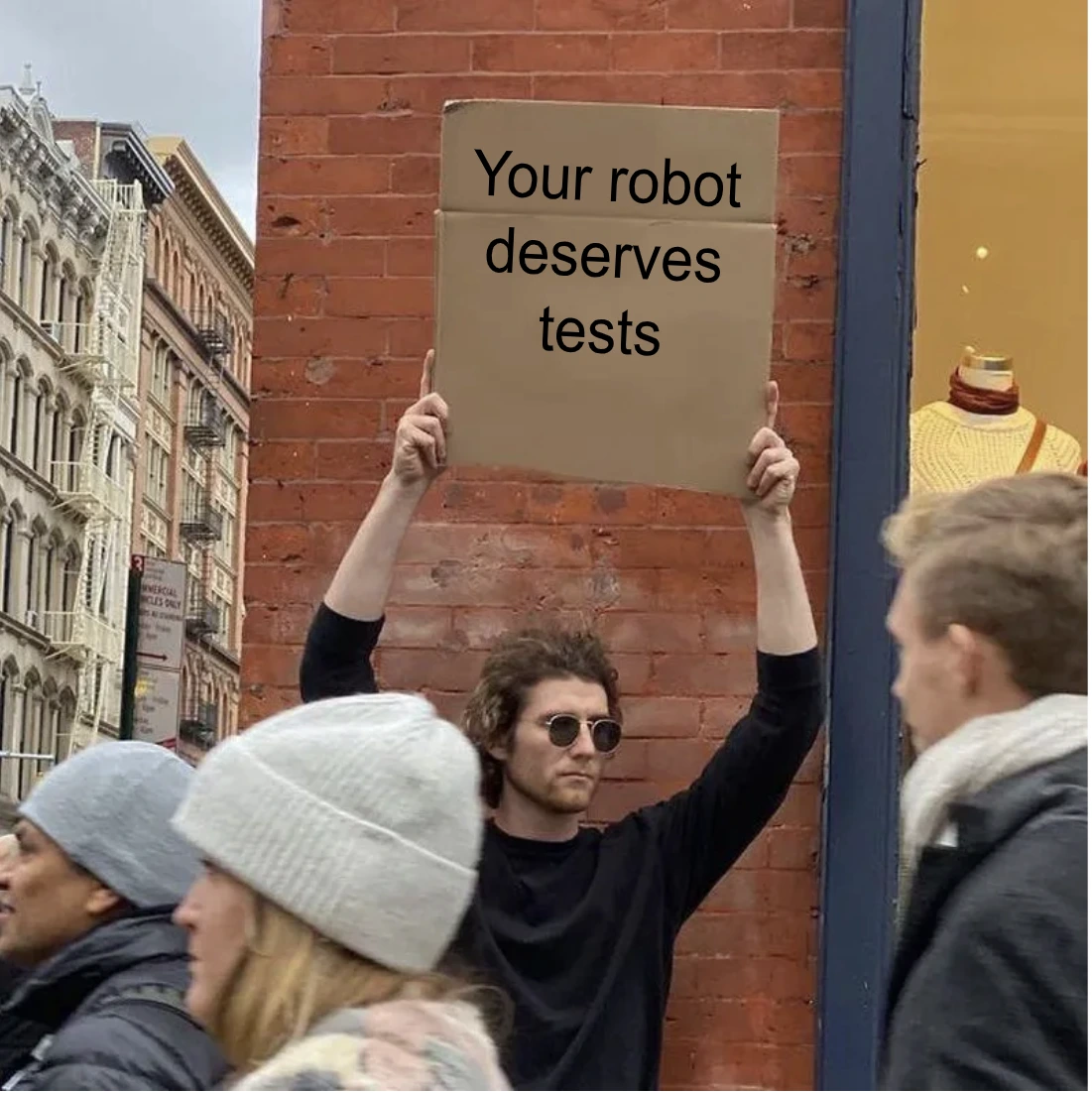
At Ekumen, we’ve spent years helping teams build reliable, maintainable ROS 2 systems. And there’s one pattern we see repeatedly: projects that treat testing as the last priority inevitably pay the price later—in time, money, and lost confidence.
If you’re building with ROS 2 and want your system to scale reliably, this is for you.
The Real Cost of Skipping Tests
One of the biggest mistakes teams make is assuming their code will “just work” once everything is wired together. But untested software has a way of failing at the worst possible moment.
Here are the failures we see most often:
- Hidden Interaction Bugs: Things behave correctly in isolation, but once components run together, unexpected interactions emerge. Without tests, these issues surface late—often during demos or field trials.
- Fear of Change: As the project grows, the team becomes reluctant to refactor or improve code: “If I touch this node, will the robot still navigate correctly?” Without tests, every change becomes a gamble.
- Late Detection: A bug caught early is cheap. A bug caught on a robot during a demo, or in a deployed system, is expensive. Fixes involve extra debugging time, system downtime, rushed patches, and sometimes even safety considerations.
Consider a situation where a developer renames a parameter during a cleanup — maybe changing detection_threshold to obstacle_threshold.
The code still compiles. The node still starts. Nothing looks wrong. But the launch file (or another part of the system) still sets the old parameter name. The node silently falls back to its default value, which alters the robot’s behavior: it becomes overly sensitive, or not sensitive enough, depending on the logic.
Everything “looks right” until you test the full system, where the robot suddenly behaves unpredictably. Without a test validating parameter declarations, this regression slips through easily and only appears during field testing.
Why Robotics Amplifies the Risk
In the real world of robotics — where nodes talk across networks, sensors behave unpredictably, hardware slows things down, and deadlines don’t delay — a single missed bug or untested change can cost far more than anticipated.
In a normal backend system you might have stable environments, predictable inputs, and tightly controlled dependencies. In robotics:
- You deal with real-world sensors, mobility, timing, and asynchronous events.
- You rely on middleware like ROS 2 that adds distributed communication, topics, services, and actions.
- You often integrate hardware, firmware, OS, drivers, and high-level logic—all at once.
- The environment changes (robot moves, conditions differ) and hardware can fail.
- Manual tests are slow, error-prone, and hard to reproduce.
In short: the surface area for failure is far larger and the cost of those failures is amplified. So testing becomes your safety net and speed lever.
The Benefits of Investing in Testing From Day One
Before diving into the benefits, it’s important to acknowledge something upfront: testing doesn’t come for free.
Writing tests takes time. Making them automatic and reliable takes even more — especially when hardware, simulation, or timing-sensitive components are involved. And once tests exist, they must evolve alongside the codebase. When APIs or node interfaces change, the tests must adapt. Outdated tests don’t just fail silently — they become misleading.
But despite this investment, the return is overwhelmingly positive. Teams that embrace testing early experience:
- Faster Development: Yes, you write more code up front (tests + design). But downstream you spend far less time chasing bugs or debugging unpredictable behavior. Teams move quicker.
- Cleaner Architecture: To test well, you naturally separate logic from nodes, abstract dependencies, and define clearer interfaces. The result is code that’s easier to maintain and extend—even months or years later.
- Reliable Releases and Predictable Deployments: A strong testing suite validates not just individual changes, but the system as a whole. Releases become predictable rather than risky.
- Confidence and Scalability: New team members onboard faster, large refactors become feasible, and a strong CI pipeline guards every pull request. Your system grows without becoming fragile.
- Reduced Hardware Bottlenecks: You don’t need the robot in the loop for every change. Simulations, mocks, and test harnesses let you validate earlier.
And in robotics — where failures can have physical consequences — that confidence is not optional; it’s essential.
How Ekumen Helps Teams Make This Real
At Ekumen, we don’t just talk about testing — we’ve lived it through the systems we’ve built, deployed, debugged, and scaled. The failures we’ve prevented and the architectures we’ve helped teams adopt all shape our practical approach.
This is what motivated us to create ROS 2 Testing: A Practical Survival Guide, a workshop we prepared for ROSCon Spain 2025. It covers:
- A clear roadmap for bringing testing and quality practices into real ROS 2 projects.
- Practical tools for implementing unit, integration, and end-to-end tests.
- CI patterns that help teams catch issues early and protect their codebase.
If your team is working with ROS 2 and wants to move from “we hope it works” to “we know it works”, we are ready to help.
Final Word
Skipping testing in robotics isn’t just risky—it’s a strategic mistake. You end up paying in time, stress, and reliability. By contrast, a strong testing strategy lets you build faster, more confidently, and sustainably.
If you are building with ROS 2 today, the best time to invest in testing was yesterday. The second best time is now.
Ready to get started?
You can explore the workshop materials here and follow them at your own pace.
Need support designing or implementing a testing strategy for your product or team?